



A compliant vape club combines the recurring-revenue advantages of a subscription model with the regulatory rigor the U.S. vape market demands — covering FDA product listing, PACT Act registration, age-gated delivery, and high-risk payment processing — so operators can serve adult consumers predictably without exposing the business to enforcement risk.
Launching an online vape club in the United States is not a typical e-commerce play. The category sits at the intersection of federal tobacco regulation, state tax law, carrier shipping restrictions, and acquirer risk policy — each layer capable of halting operations if overlooked. This guide walks vape product professionals and operators through the structural decisions required to stand up a membership program that is both commercially viable and compliance-ready.
What Is a Vape Club?
A vape club is a membership-based retail model in which adult consumers subscribe to receive curated vape products — typically disposable devices, pre-filled pods, or refillable hardware — on a recurring schedule, often paired with exclusive access, loyalty pricing, or product education. Unlike a one-time online store, the vape club optimizes for retention and predictable recurring revenue rather than single-transaction conversion.
Membership Model vs. Traditional Vape Retail
| Dimension | Traditional Online Vape Retail | Vape Club Membership |
| Revenue pattern | Transactional, unpredictable | Recurring, subscription-based |
| Customer relationship | Acquisition-focused | Retention- and LTV-focused |
| Age verification | Per-transaction check | Verified-once, persistent member profile |
| Fulfillment cadence | On-demand per order | Scheduled cycles (weekly, monthly) |
| Data depth | Limited per order | Rich longitudinal member data |
| Compliance posture | Repeated point-of-sale gates | Centralized member compliance file |
The distinction matters for compliance: because a vape club holds a persistent member profile, age verification, shipping address validation, and state tax registration can be managed once and maintained over time — reducing per-transaction friction while tightening auditability.
Why Membership Models Work for the U.S. Vape Market
The U.S. vape market's structural pressures — high customer acquisition cost (CAC), restrictive advertising channels, and carrier-driven shipping friction — make recurring-revenue models especially attractive. A vape subscription business model converts the category's acquisition difficulty into a retention advantage: when a single verified adult member converts once, the vape club captures that customer's lifetime value (LTV) across multiple scheduled deliveries rather than re-winning them each cycle.
Customer Retention and Predictable Revenue
A well-structured vape membership program shifts the revenue mix from volatile one-off orders toward a predictable subscription base. This predictability supports three operational advantages:
- Inventory planning: Scheduled delivery cycles let operators forecast SKU demand weeks ahead, reducing overstock of age-restricted inventory that cannot be freely liquidated.
- Supply chain negotiation: Recurring volume commitments improve leverage with manufacturers on pricing, lead times, and compliant product allocation.
- Valuation and financing: Recurring revenue streams are typically valued at a premium and are more attractive to category-aware payment processors and lenders.
Industry benchmarks for subscription commerce consistently show that recurring models outperform transactional retail on net revenue retention, and the principle applies directly to a vape club operating within legal guardrails.
Legal Framework: FDA and PACT Act Compliance
No vape club can operate in the United States without a working understanding of two overlapping federal regimes: the FDA's tobacco product regulations and the PACT Act as amended by the CONTRACE Act. Together, they define what may be sold, how it must be registered, and how it may be shipped.
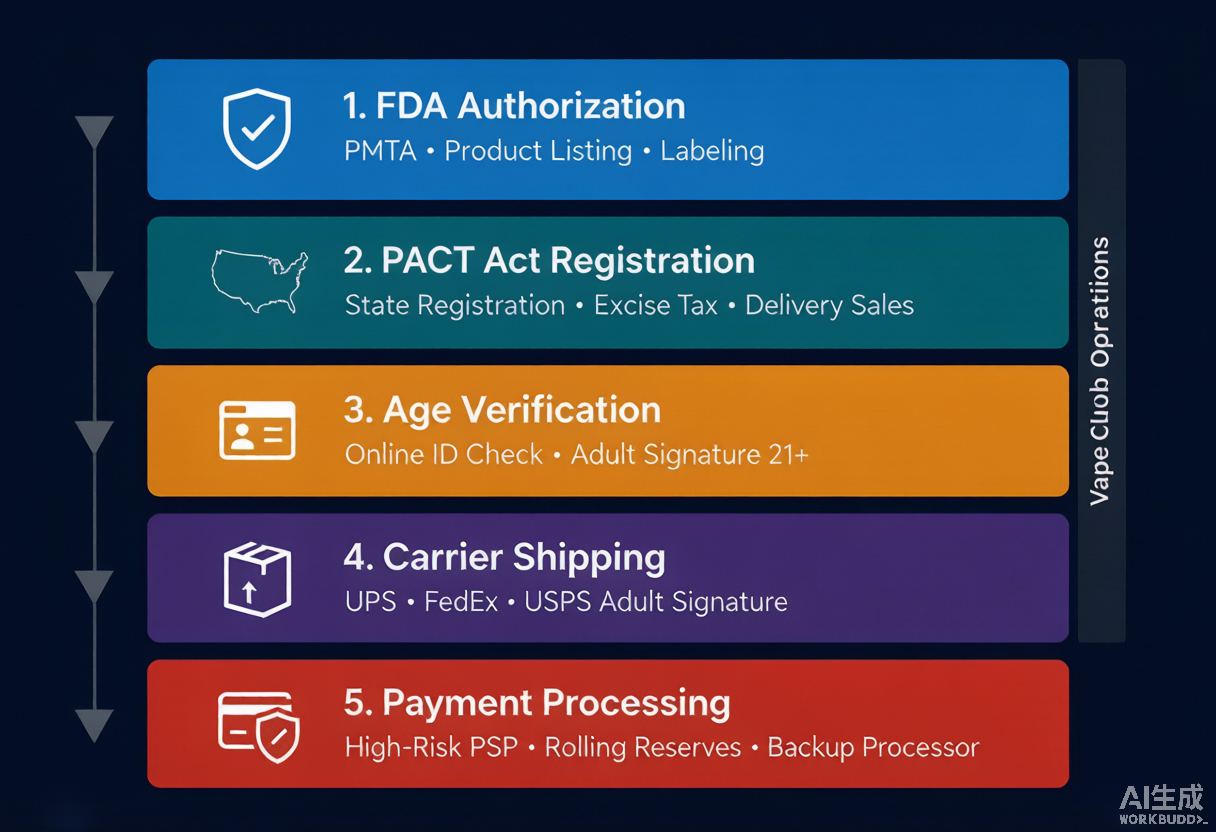
The diagram above maps the five compliance layers that every vape club must satisfy simultaneously. A weakness in any single layer — an unregistered state, an unauthorized SKU, a missing adult signature, a frozen merchant account — can halt the entire operation. The sections below address each layer in operational detail.
FDA Regulation of Vape Products
The U.S. Food and Drug Administration, through its Center for Tobacco Products (CTP), regulates all Electronic Nicotine Delivery Systems (ENDS) as tobacco products. For a vape club, the key FDA obligations are:
- Premarket authorization: Products must have a marketing authorization pathway — a Premarket Tobacco Product Application (PMTA) granted, or an exemption allowing continued marketing during review. Operators should confirm each SKU's authorization status before listing it in a membership tier.
- Product listing: Manufacturers and importers must submit product listings to FDA, including ingredients, HPHC (harmful and potentially harmful constituent) reporting, and labeling.
- Labeling and warning requirements: Product packaging and advertising must carry the required nicotine warning statement and comply with advertising restrictions targeting youth.
A vape club's compliance file should document each listed product's FDA status and retain the authorization record, so that the membership catalog reflects only legally marketable items.
PACT Act and Mail-Order Vape Sales
The Prevent All Cigarette Trafficking (PACT) Act, expanded by the CONTRACE Act effective 2021, classifies ENDS products as "cigarettes" under the statute's registration and reporting regime. The practical consequences for a vape club are significant:
- State registration: Vape sellers shipping into a state must register with that state's tobacco tax administrator under the PACT Act before making any delivery sale into the state.
- Excise tax reporting and remittance: Operators must file regular PACT Act reports with state tax authorities, disclosing sales volumes and remitting applicable excise taxes.
- Delivery sales restrictions: The Act imposes delivery sale requirements, including age verification at point of order and at delivery, and prohibits certain shipments via the U.S. Postal Service to non-compliant sellers.
Because vape club compliance obligations vary state by state, operators typically maintain a jurisdiction matrix tracking registration status, tax rates, and any state-specific delivery restrictions before accepting members in each state.
State-by-State Variation
Beyond federal law, states impose their own vape excise taxes, flavor restrictions, online sale bans, and licensing requirements. A compliant vape club must:
- Maintain a state eligibility map showing where it can lawfully enroll members and ship product.
- Apply state-specific excise tax collection at checkout for subscribed members.
- Restrict enrollment and shipping for states that prohibit remote vape sales entirely.
- Renew state registrations and licenses on each jurisdiction's cycle.
Age Verification and Delivery Compliance
Age verification is the single most operationally critical gate in a vape club. Federal law requires that no vape product be sold to anyone under the federal minimum age of 21, and both online and delivery stages must enforce this.
Online Age Verification Technology
A compliant online vape club implements identity and age verification at account creation and at each recurring billing event. Best-practice approaches layer multiple verification methods:
- Identity-based verification: Third-party age verification services (e.g., providers matching government ID data against authoritative databases) confirm a member's age and identity at enrollment.
- ID document scanning: Upload-and-check of a government-issued photo ID, often paired with biometric liveness checks, for higher-assurance verification.
- Database attestation: Cross-referencing name, address, and date of birth against public records to establish age.
Because the vape club model retains a member profile, verification can be completed once at enrollment and re-affirmed periodically, reducing checkout friction for returning subscribers while maintaining a defensible compliance record.
Delivery Signature and Adult Signature Requirements
The shipping stage requires a second, independent age check. Carriers offering adult-signature services verify the recipient's age (typically 21+) at the point of delivery and require a signature. A vape club's fulfillment workflow must:
- Flag every outbound vape shipment as requiring adult signature on delivery.
- Configure carrier service types that support adult signature (not all service levels do).
- Handle failed-delivery retries and member re-scheduling without shipping to an unverified recipient.
- Retain proof-of-delivery records with the adult signature capture for audit purposes.
Carrier Shipping Policies: UPS, FedEx, and USPS
Carrier policy is a distinct compliance layer from law. Each major U.S. carrier maintains its own rules for transporting ENDS products:
| Carrier | Vape Product Shipping Policy | Key Considerations |
| UPS | Permits ENDS with strict compliance requirements | Adult signature required; shipper must meet UPS tobacco policy terms |
| FedEx | Permits ENDS under controlled conditions | Adult signature (21+) required; specific packaging and labeling rules apply |
| USPS | Restricted; PACT Act non-compliant shipments prohibited | Only PACT Act-compliant, registered sellers may use USPS for ENDS; broad practical restrictions |
A vape club should formally enroll in each carrier's tobacco/ENDS shipping program, train fulfillment staff on the specific documentation each carrier requires, and never assume a general shipping label suffices for age-restricted product.
Payment Processing for Vape Clubs
Payment processing is one of the most underestimated barriers to operating a vape club. The vape category is classified as high-risk by the vast majority of U.S. acquirers, and a standard payment gateway will typically freeze or terminate a vape merchant account once the business model is identified.
Why Vape Merchants Are High-Risk
Acquirers and payment processors categorize vape businesses as high-risk for several interlocking reasons: regulatory exposure, chargeback propensity in age-gated subscriptions, reputational risk, and the threat of enforcement actions against the broader payment ecosystem. The practical effect is that a vape club cannot simply sign up for a mainstream gateway and expect stability.
Choosing a High-Risk Merchant Account
A vape club's payment strategy should be built around specialized high-risk PSPs (payment service providers) with documented experience in the vape and tobacco category. Key selection criteria include:
- Category expertise: The PSP must have a demonstrated history of underwriting vape and ENDS merchants, including subscription billing.
- Subscription support: The processor must support recurring billing, card-on-file tokenization, and Account Updater services to manage card expirations across the membership base.
- Chargeback management: Robust chargeback defense tooling and representment support, given that age-restricted recurring billing attracts disputes.
- Reserve and underwriting terms: Understand rolling reserves, holdback percentages, and underwriting documentation requirements before committing.
A best-practice vape club maintains at least two processing relationships to avoid single-point-of-failure risk, since vape merchant accounts can be terminated or frozen with limited notice.
Product Selection and Supply Chain
The membership catalog is both a commercial lever and a compliance document. Each product in a vape club tier must be sellable, shippable, and documented — which requires a disciplined product selection process. Product quality testing should inform which SKUs enter the catalog: see Leak Testing Protocol for Disposable Vapes for the standardized leak-integrity method, and Airflow Pressure Drop Testing for Vape Devices for the aerodynamic performance benchmarks that separate reliable hardware from failure-prone units.
Disposable vs. Refillable Devices
A vape club's product mix shapes its operational complexity. Two dominant device categories define the catalog decision:
- Disposable, closed-system devices: Pre-filled and pre-charged, single-use devices dominate consumer demand and simplify fulfillment (no e-liquid handling). However, they carry heightened regulatory scrutiny and environmental considerations, and SKU turnover is fast as manufacturers update authorized product lists. For rechargeable disposables, USB-C charging safety is a product-quality gate — see USB-C Charging Safety for Vape Devices for the electrical and compliance considerations that should inform SKU selection.
- Refillable, open-system hardware: Bottled e-liquid and refillable devices offer margin diversity and longer product life, but introduce e-liquid shipping classification, child-resistant packaging, and broader state flavor restrictions.
Most successful vape clubs tier their catalog: entry-level disposable-focused tiers for convenience-oriented members, and hardware-plus-e-liquid tiers for experienced users — each tier built only from compliant, authorized SKUs.
Managing a Compliant Product List
A compliant product list is a living document. Operators should maintain a master SKU registry capturing, for each product:
- FDA marketing authorization status and PMTA reference.
- Manufacturer and importer of record.
- Nicotine concentration and formulation.
- State-specific eligibility (flavor bans, concentration caps).
- Required labeling and warning compliance status.
For a source-first methodology on building and maintaining this registry — including the four-level evidence model (SOURCE_EXPLICIT, DERIVED, ESTIMATED, VERIFIED_INTERNAL) that separates manufacturer-confirmed data from estimates — see Verify Vape Specifications: A Source-First Publishing Guide. That framework prevents unverified numbers from propagating into your membership catalog, packaging, and schema markup.
When FDA updates its enforcement priorities or authorization list, the vape club's catalog must be updated in lockstep — removing or restricting any SKU that loses marketability. This ongoing maintenance is a core operational cost of a compliant vape membership.
Building the Membership Tier Structure
The tier structure is where commercial strategy meets compliance. A well-designed vape club tier model aligns product value, delivery cadence, and regulatory complexity into clear member offerings.
Tier Design Principles
Effective vape club tiers share several design principles:
- Clear value differentiation: Each tier should offer a distinct product bundle and cadence so members self-select based on consumption pattern, not just price.
- Compliance-aware cadence: Subscription frequency should reflect lawful purchase quantity limits and reasonable personal-use volume, avoiding tiers that imply bulk redistribution.
- Transparent pricing: All-in pricing — including state excise tax, shipping, and adult-signature fees — should be surfaced at enrollment to reduce chargebacks from unexpected charges.
- Flexible cadence: Monthly, bi-monthly, and quarterly cycles accommodate different consumption rates and reduce involuntary churn from over-delivery.
Subscription Cycle and Pricing Strategy
Pricing a vape club subscription requires modeling the fully loaded cost per member: product COGS, state excise tax (varies by ship-to state), adult-signature shipping surcharge, payment processing fees (higher for high-risk), age verification cost, and a contribution to compliance overhead. A sustainable tier price must cover all of these plus margin — and still present clear value versus a member buying the same products transactionally.
Marketing Within Regulatory Limits
Marketing a vape club is constrained on nearly every mainstream channel. FDA advertising restrictions, platform prohibition policies, and state flavor-advertising rules collectively limit where and how a vape membership can be promoted — making owned-channel and SEO strategy disproportionately important.
The Compliance Boundary for Vape Marketing
Vape club marketing must avoid several high-risk practices: youth-appealing imagery or messaging, health or cessation claims, lifestyle improvement promises, and any advertising on channels that prohibit tobacco and ENDS promotion. Content should be factual, product- and compliance-focused, and directed only to adults of legal age.
SEO and Content Marketing as the Primary Channel
Because paid acquisition channels are largely closed or unreliable for vape, a compliant vape club's growth engine is typically organic search and content marketing:
- Informational SEO content: B2B and technical guides (like this one) addressing compliance, product specifications, and operational questions — targeting professionals and informed adult consumers.
- Product and specification pages: Detailed, structured product pages optimized for model-specific and category search terms, with full specifications and compliance disclosures.
- Educational resources: Member-facing guides on device specifications, usage, and responsible disposal, reinforcing E-E-A-T signals.
- Email and member lifecycle: Owned email to verified members is one of the few reliable retention channels, and should be built into the membership onboarding flow.
Within content, operators must rigorously avoid any claim that a vape product helps quit smoking, reduces harm, treats a condition, or improves health — these are prohibited claims that invite enforcement.
How a Compliant Vape Club Improves Customer Trust and Retention
Compliance is often framed as a cost center, but for a vape club it is a core trust signal and retention driver. Adult consumers in a heavily restricted category gravitate to operators who visibly invest in age verification, authorized products, transparent tax handling, and reliable adult-signature delivery.
Compliance as a Differentiator
A vape club that publishes its compliance posture — FDA-authorized catalog, PACT Act registration, third-party age verification, adult-signature shipping — differentiates itself from non-compliant or grey-market operators. Vape membership program compliance is not a one-time checkbox; it is an ongoing operational discipline that links product authorization, specification verification, device quality testing, and airflow performance benchmarks into a single auditable member experience. The trust effect compounds over the membership lifecycle: verified members who receive reliable, lawfully shipped product have lower churn, fewer chargebacks, and higher willingness to expand tiers. Compliance, executed consistently, becomes the brand promise of a durable vape club.
Frequently Asked Questions
Can a vape club legally ship to all 50 U.S. states?
No. A compliant vape club must maintain a state eligibility map and restrict enrollment and shipping where state law prohibits remote vape sales, imposes flavor bans, or requires registrations the operator has not completed. PACT Act registration is required for each state the club ships into, and some states effectively bar online vape delivery altogether.
Is age verification required for every vape club shipment?
Yes. Federal law requires age verification both at the point of online order and at delivery. A vape club verifies age at enrollment using identity-based verification and again at delivery through adult-signature services provided by UPS, FedEx, or compliant USPS channels. Proof-of-delivery records with adult signature must be retained.
Can a vape club use a standard payment processor like Stripe or PayPal?
Generally, no. Mainstream processors classify vape and ENDS as high-risk and typically decline, freeze, or terminate vape merchant accounts. A vape club should work with specialized high-risk PSPs experienced in the vape category, support recurring billing, and ideally maintain multiple processing relationships to avoid single-point-of-failure risk.
What products can a vape club legally include in its catalog?
Only vape products with a valid FDA marketing authorization pathway — a granted PMTA or an applicable exemption permitting continued marketing — may be included in a vape club catalog. Each SKU must also meet state-specific requirements on flavor, nicotine concentration, and labeling. The catalog should be maintained as a living document and updated whenever FDA or state rules change.
Sources and Methodology
This article synthesizes publicly available regulatory and industry information, including:
- U.S. Food and Drug Administration (FDA), Center for Tobacco Products (CTP) — guidance on Electronic Nicotine Delivery Systems (ENDS) regulation, premarket authorization (PMTA), and product listing requirements.
- PACT Act, 15 U.S.C. § 376 (eCFR) — as amended by the Consolidated Appropriations Act of 2021 (CONTRACE Act provisions extending PACT Act coverage to ENDS), including state registration, reporting, and delivery sale requirements.
- Congress.gov — H.R. 3962, Preventing Online Sales of E-Cigarettes to Children Act — the CONTRACE Act legislative text that brought ENDS products under the PACT Act regime.
- UPS — Tobacco Shipping Policy — published carrier requirements for shipping tobacco and ENDS products, including adult signature service.
- FedEx — Alcohol and Tobacco Shipping — carrier conditions for transporting ENDS under controlled shipments with adult signature (21+).
- U.S. Postal Service — Tobacco Product Mailability — USPS restrictions on mailing tobacco and ENDS products, including PACT Act compliance requirements for registered sellers.
- U.S. FDA — Vaping Products and E-Cigarettes — resource page covering ENDS product regulation, marketing authorization, and enforcement priorities.
- Publicly documented high-risk merchant account underwriting practices and payment service provider category policies for vape and tobacco merchants.
- State tobacco tax administrator guidance and state-level statutes governing online vape sales, excise tax, flavor restrictions, and licensing.
Methodology: Content was structured around the B2B technical informational search intent for the primary keyword "vape club" and related secondary keywords. Regulatory frameworks were summarized from public authoritative sources at the time of last review. This article does not constitute legal advice; vape club operators should engage qualified U.S. regulatory counsel for jurisdiction-specific compliance review before launch and retain counsel for ongoing monitoring, as FDA and state vape regulations change frequently.